Many learners sign up for IELTS preparation full of motivation, then feel lost within a few weeks: long sentences in Reading don't make sense, Writing is full of tense errors, familiar words slip past in Listening, and Speaking comes out in fits and starts. In most cases the problem is not IELTS itself but a foundation that isn't yet strong enough for exam preparation. Pre-IELTS is designed to fill exactly that gap.
Quick summary
Pre-IELTS is the foundation stage before in-depth IELTS preparation courses.
The course covers four areas: core grammar, using grammar in speaking and writing, IPA-based pronunciation, and short IELTS-style tasks.
Target outcome: around level A2, a foundation roughly equivalent to IELTS 0–4.0.
Suited to beginners, learners who have lost their basics, or anyone who tried IELTS and found it too much.
Why IELTS progress can stall
IELTS tests four skills: Listening, Reading, Writing and Speaking. The exam assumes you already have basic grammar, common vocabulary and reasonably clear pronunciation. Without them, each skill tends to break down in a familiar place:
Reading: you know each word but not the sentence, because you can't yet see how long sentences are built.
Writing: you have ideas but express them with the wrong tense or structure, in disconnected sentences.
Listening: you miss words you know, because you pronounce them differently yourself.
Speaking: you hesitate, worry about mistakes and hold back.
Studying IELTS without a foundation is like building a house without footings: the higher it goes, the shakier it gets. Exam tips only help once you can understand the language in the questions.
Signs you should start with Pre-IELTS
You are not yet confident with tenses and basic sentence structures.
Writing a sentence or a short paragraph in English is a struggle.
You can't read the IPA chart yet, and your pronunciation is based on guesswork.
You lack confidence when listening and speaking.
You want to take IELTS but don't know where to begin.
If two or three of these sound familiar, a foundation stage will help you move faster in later courses.
What the Pre-IELTS course covers
1. Grammar Foundation
A systematic review of tenses and key sentence structures. The focus is on understanding why one structure fits and another doesn't, rather than memorising formulas.
2. Writing & Grammar Application
Learn to write a correct sentence, then extend and link sentences into a paragraph. Grammar is put straight into speaking and writing so it doesn't stay on the worksheet.
3. IPA & Pronunciation
Practise the International Phonetic Alphabet and work on pronunciation, word stress and intonation from the start with foreign teachers. Once you say a word correctly, it also becomes easier to recognise when you hear it.
4. IELTS Foundation Practice
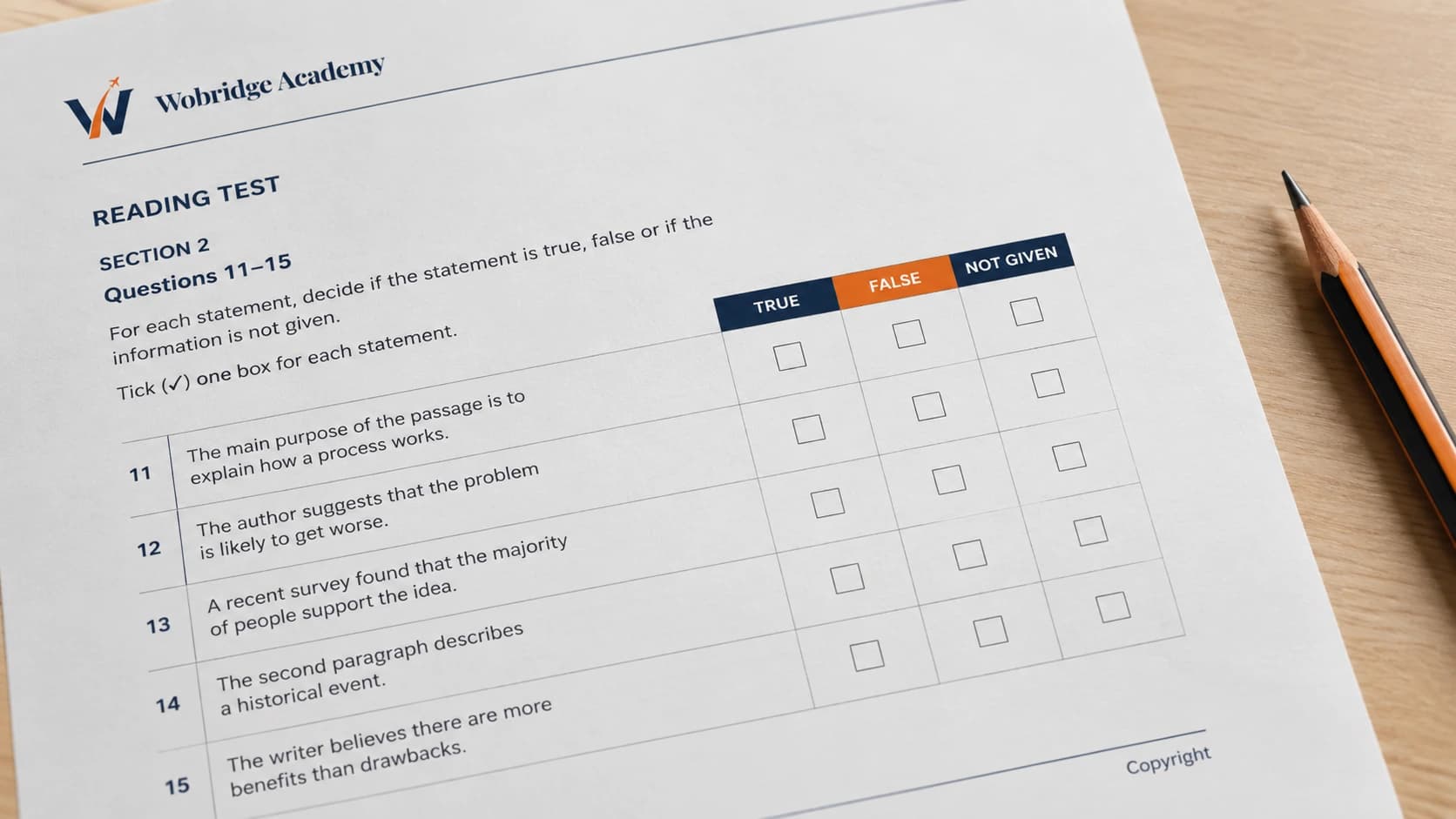
Work on short IELTS tasks that follow the real exam format, building test-taking skills step by step and getting used to exam pressure before moving on to in-depth courses.
Target outcomes
| Area | Target |
|---|---|
| English level | Around A2 |
| IELTS foundation | Roughly equivalent to 0–4.0 |
| Grammar and vocabulary | A stronger grasp of core grammar and vocabulary |
| Use | Able to use English in conversation and in writing |
| Next step | Ready for in-depth IELTS courses from 4.0 upward |
These are the programme's goals. Everyone progresses at a different pace depending on their starting point and practice time, which is why Wobridge runs a placement check first and plans the route from there.
Who this course is for
Beginners and learners who have lost their English basics.
School and university students who want to prepare early for IELTS.
Working adults who need to rebuild their foundation before exam prep.
Anyone who tried IELTS, found it too much and wants to relearn it properly.
Where to start
The first step is knowing where you stand. Request a consultation for a placement check and advice on the right route and fees, or see the details of the Pre-IELTS course.
To get a feel for the exam ahead, read about the IELTS test format and how pronunciation affects communication.
Going slowly and steadily beats rushing ahead and having to start over.
Topics
- Overview
- Study plan
- Pronunciation