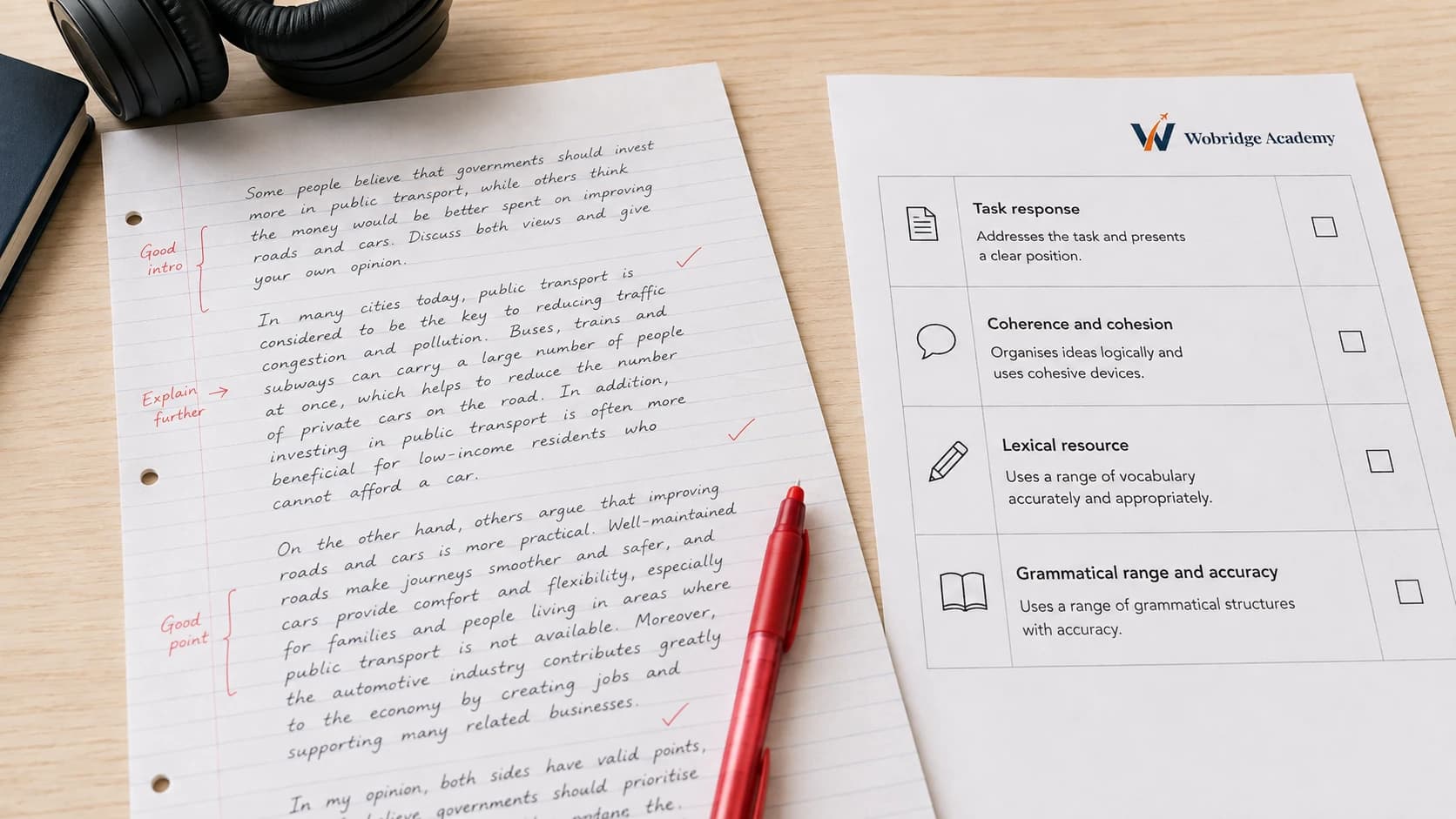
The four criteria carry equal weight, so half a band on your weakest is worth exactly as much as half a band on your strongest — and the weakest is far easier to move.
This article describes each criterion by the question it asks, and the practice that answers it.
What the four criteria measure
| Criterion | The question it asks |
|---|---|
| Task response | Does the response answer every part of the prompt, with a clear position? |
| Coherence and cohesion | Can the reader move from one idea to the next without going back? |
| Lexical resource | Are the words accurate and natural? |
| Grammatical range | Are the structures varied, and are they correct? |
The criterion most often neglected
Most learners pour their time into vocabulary and grammar, because those can be taught as lists. But the criterion that costs the most marks is usually the first one — task response.
An off-topic response, however well written, is capped on that criterion, and the cap drags the overall band down with it. Reading the prompt twice and underlining each part you must answer is the most valuable two minutes of the task.
Three common task-response failures
Answering half of a two-part question (listing benefits, forgetting drawbacks).
Stating one position in the introduction and a different one in the conclusion.
Writing generally about the topic instead of answering the question asked.
Coherence is not linking words
Sprinkling “Moreover”, “In addition” and “Furthermore” across your paragraphs does not make a response coherent — often the reverse, because a connector signalling the wrong relationship forces the reader to stop.
Coherence comes from the order of ideas: one idea per paragraph, stated in the first sentence, supported by the rest. Once the order is right, most connectors become unnecessary.

How to practise
Hunt one kind of problem per pass. Four short passes surface more than a single read-through looking for “anything wrong”, because eyes cannot search for four things at once.
Keep a list of your own repeat offences. After a handful of responses that list usually holds four or five items — and fixing those moves the band faster than learning new structures.
This description follows the test provider's published band descriptors. Check the latest materials.
Topics
- Writing
- Marking criteria