DELF and DALF are the two official French-language diplomas, laid out across the six levels of the Common European Framework of Reference (CEFR), from A1 to C2. This guide explains how the two differ, what each exam looks like, how passing is scored and where to start preparing for DELF B2.
Quick answer
DELF has four levels: A1, A2, B1, B2. DALF has two: C1 and C2.
The diplomas are valid for life; there is nothing to renew.
You can sit the level that suits you without holding the ones below it.
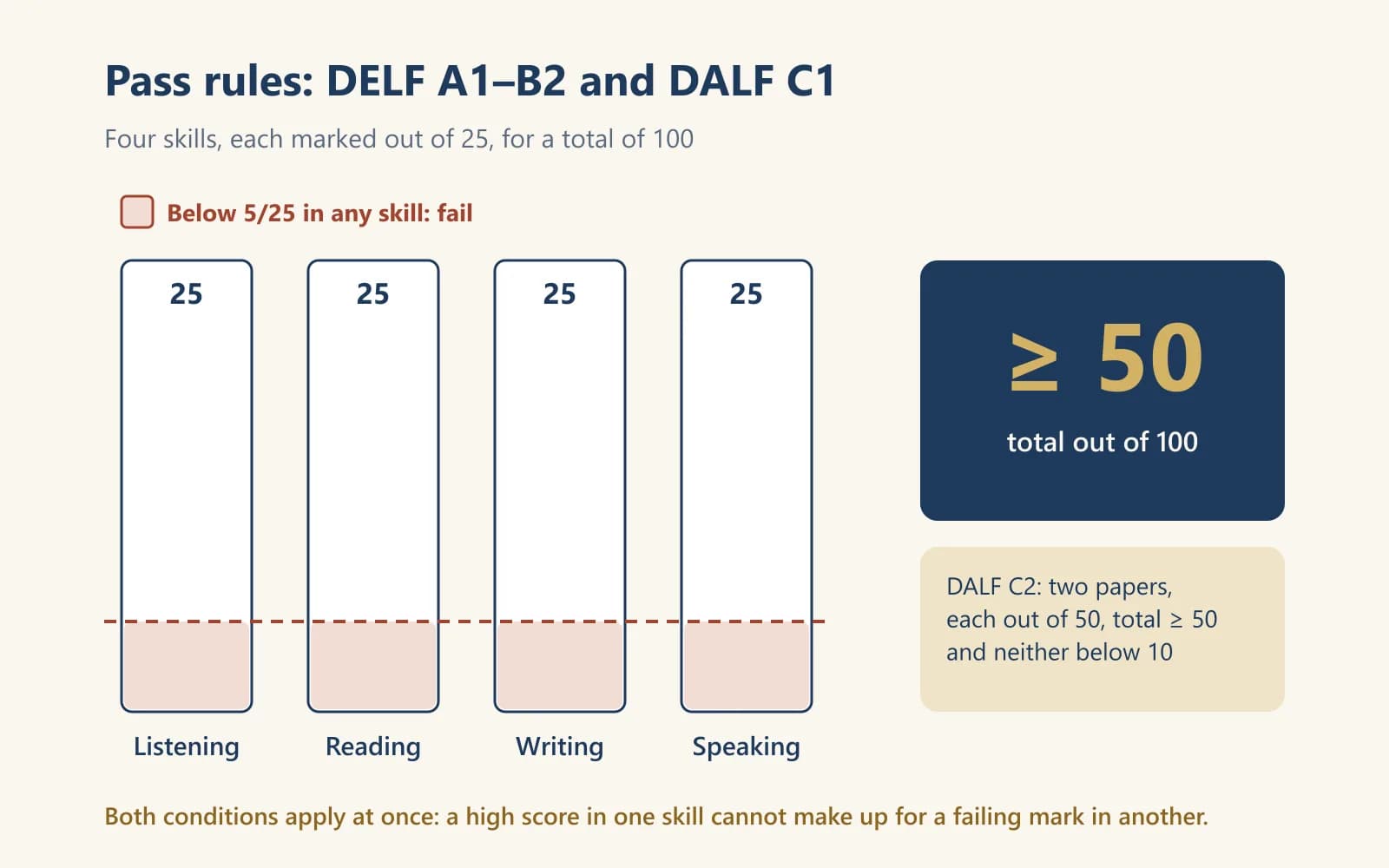
You pass with at least 50/100 overall and no skill below 5/25.
DELF B2 is the level many people aim for to study or work in French.
What DELF and DALF are
DELF (Diplôme d’études en langue française) is a French diploma with four levels: A1, A2, B1 and B2. DALF (Diplôme approfondi de langue française) is the advanced diploma, with two levels: C1 and C2.
Both are awarded by the French Ministry of National Education. Outside France the exams are run under France Éducation international (formerly CIEP). Each level is a diploma in its own right: you can go straight for B2 without A1, A2 or B1.
| Diploma | Level | What you can do in French |
|---|---|---|
| DELF A1 | Beginner | Introduce yourself, ask and answer simple, familiar questions |
| DELF A2 | Elementary | Handle everyday situations, describe yourself and where you live |
| DELF B1 | Intermediate | Cope with most familiar situations, recount experiences, briefly explain a view |
| DELF B2 | Upper intermediate | Follow complex content, talk fairly naturally, argue a point clearly |
| DALF C1 | Advanced | Use French flexibly and effectively for study and work |
| DALF C2 | Proficient | Understand in depth, synthesise information, express complex ideas precisely |
DELF and DALF are valid for life, which makes them a long-term investment in your language profile. Even so, when you apply to a programme or complete a formal procedure, check which level the receiving body asks for and whether it accepts older diplomas.
Four DELF versions for different ages
The versions differ only in topics, texts and situations suited to each age group. The level and the diploma awarded are the same.
| Version | For | Levels |
|---|---|---|
| DELF Prim | Primary-school children | A1.1, A1, A2 |
| DELF junior / scolaire | Teenagers in secondary school | A1, A2, B1, B2 |
| DELF tout public | Older teenagers and adults | A1, A2, B1, B2 |
| DALF | Advanced learners | C1, C2 |
Working adults and future students usually sit the tout public version. The figures below follow that version.
Exam structure at each level
DELF A1 to B2 and DALF C1 all test four skills: listening, reading, writing and speaking. As the level rises, tasks move from exchanging simple information to analysing, synthesising and defending a position.
DELF A1 and A2: everyday communication
A1 asks you to understand simple information, fill in a form, write a short message and introduce yourself. At A2 you need to describe personal experiences and handle everyday exchanges such as inviting, thanking, apologising or asking for information.
| Paper | DELF A1 | DELF A2 |
|---|---|---|
| Listening | About 20 min | About 25 min |
| Reading | 30 min | 30 min |
| Writing | 30 min | 45 min |
| Speaking | 5–7 min, 10 min prep | 6–8 min, 10 min prep |
DELF B1: recounting and explaining a view
B1 tests fairly independent use of French. You need to grasp the main points, recount events and give reasons for your choices.
| Paper | Main task | Time |
|---|---|---|
| Listening | Listen to recordings and answer questions | About 25 min |
| Reading | Find information and main ideas in texts | 45 min |
| Writing | One opinion piece, at least 160 words | 45 min |
| Speaking | Interview, interaction, expressing a view | 15 min, 10 min prep |
Note: the B1 reading paper is now 45 minutes. Many older materials still say 35.
DELF B2: analysing and defending an argument
At B2, describing or retelling is not enough. You have to weigh up an issue, compare options and defend your view with reasons.
| Paper | Main task | Time |
|---|---|---|
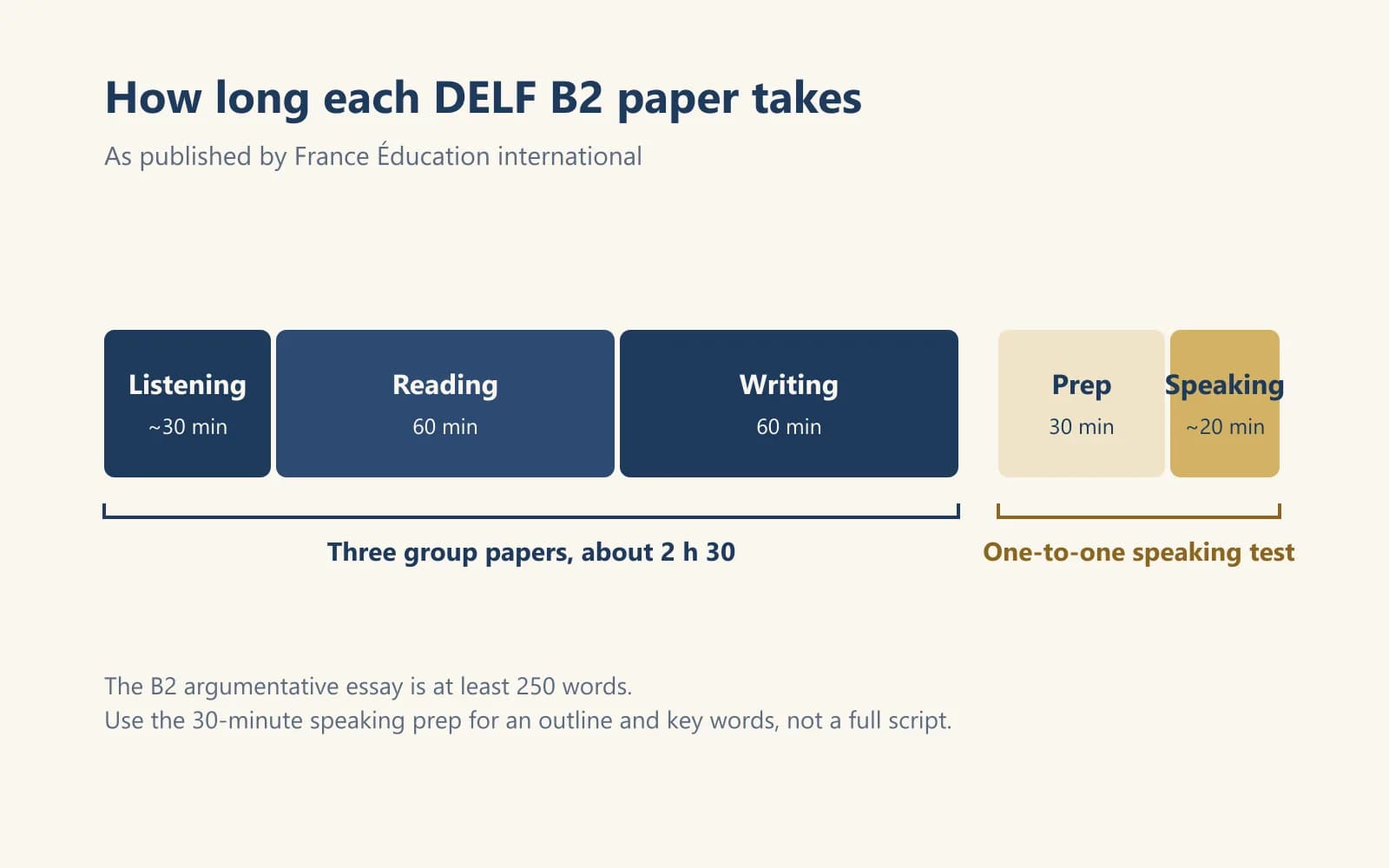
| Listening | Follow the content, views and arguments in recordings | About 30 min |
| Reading | Analyse informative and argumentative texts | 60 min |
| Writing | An argumentative text, at least 250 words | 60 min |
| Speaking | Present a view on a short document, then discuss it with the examiner | About 20 min, 30 min prep |
DALF C1: long, complex academic tasks
C1 expects you to understand long documents, pick up on implied meaning and speak and write in a structured way on complex topics. The writing paper combines a synthesis of documents with an argumentative essay; the speaking paper is a presentation built from given documents, followed by a discussion with the examiner.
| Paper | Time |
|---|---|
| Listening | About 40 min |
| Reading | 50 min |
| Writing | 2 h 30 |
| Speaking | 30 min, 1 h prep |
DALF C2: two integrated papers
C2 combines the four skills into two papers. You must take in information accurately, then synthesise it and present it in your own words.
| Paper | Main task | Time |
|---|---|---|
| Listening and speaking | Summarise recordings, develop a view, debate with the examiner | About 30 min, 1 h prep |
| Reading and writing | Write a structured text from a set of documents | 3 h 30 |
One change to know about: since 2020, France Éducation international has been moving the DELF listening and reading papers towards multiple-choice questions, with fewer written answers. The switch has run over several years, so older and newer papers may differ in the number of tasks and the way you answer. When you practise, check which format a resource follows and always read the instructions on the paper. The most up-to-date details are on France Éducation international’s DELF tout public and DALF pages.
How scoring and passing work
For DELF A1 to B2 and DALF C1, each skill is marked out of 25, for a total of 100. You must meet both conditions:
At least 50/100 overall.
No skill below 5/25.
DALF C2 has two papers, each marked out of 50. You need at least 50/100 overall and neither paper below 10/50.
That is why working on all four skills evenly matters more than polishing the one you are already good at.
Why DELF B2 is worth aiming for
B2 is where you use French independently and with confidence: you can read complex texts, join discussions and present a clear point of view.
For study: B2 is the language requirement of many programmes in France, but the exact rule depends on the institution, subject and level. Check the admission requirements of the programme you plan to apply to.
For work: getting to B2 builds skills you can use straight away, such as writing formal letters, presenting proposals and explaining choices.
For the next step: the analytical reading, note-taking, argument and rebuttal you practise at B2 are the foundation for DALF C1 and C2.

How to prepare for DELF B2
Know where you stand before choosing a date
Sit one full paper under timed conditions to see your strengths and weaknesses in each skill. Wobridge’s French practice page has DELF papers from A1 to B2, split into listening, reading, writing and speaking, with 10 papers per skill at each level.
Listening and reading: follow the whole, not every word
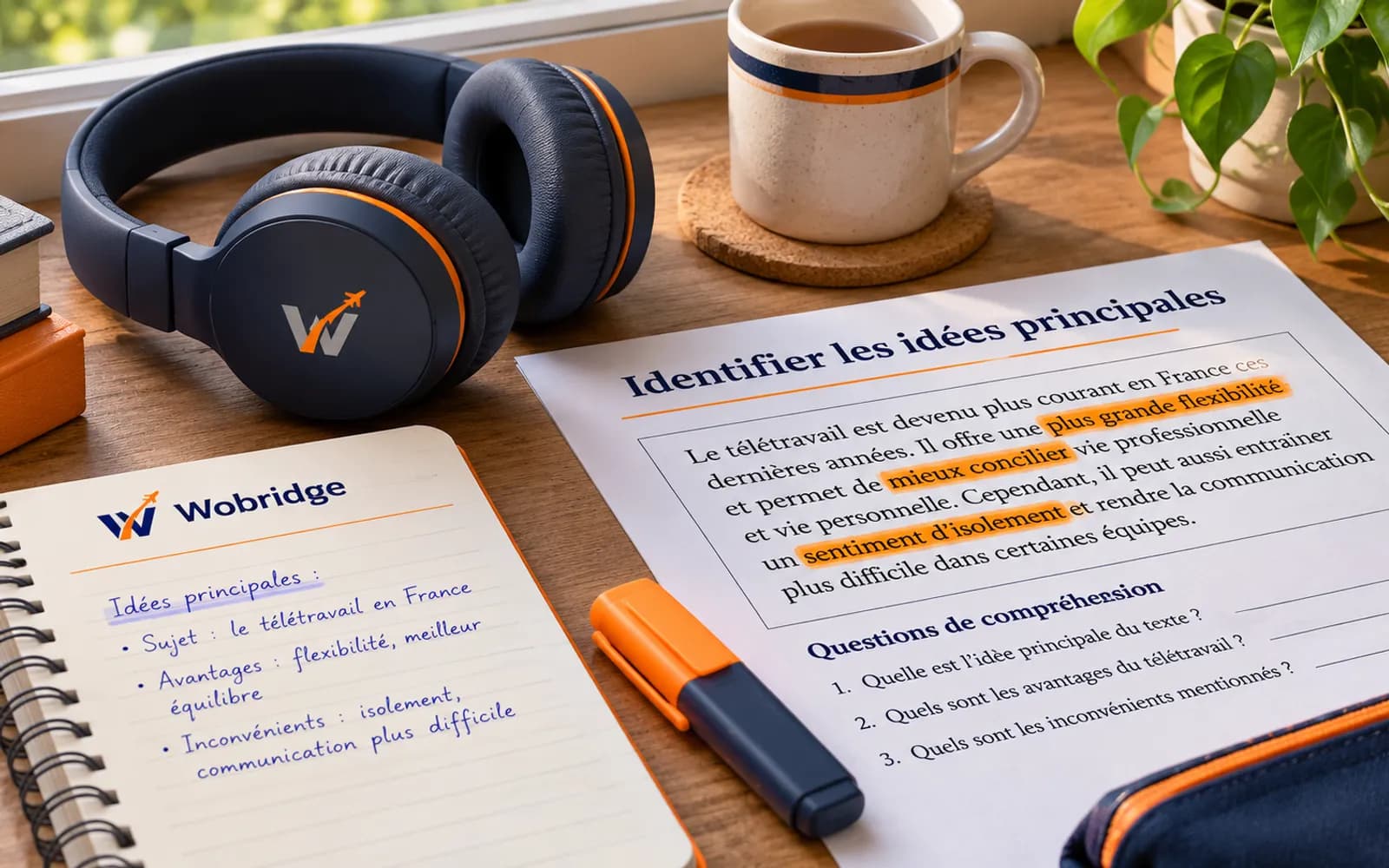
When listening, read the questions first, note key words and listen for signposting. Rather than chasing every word, work out whether the speaker is agreeing, objecting, explaining or giving an example.
When reading, separate facts from the author’s opinion and track the main idea of each paragraph and how the arguments connect. Do not pick an answer just because it repeats a word from the text.
Writing: the right task for the right reader
Before you write, decide the purpose of the text, who will read it and the right register, then choose your arguments and examples. Afterwards, check length, cohesion and common slips in verb forms, gender, number and prepositions.
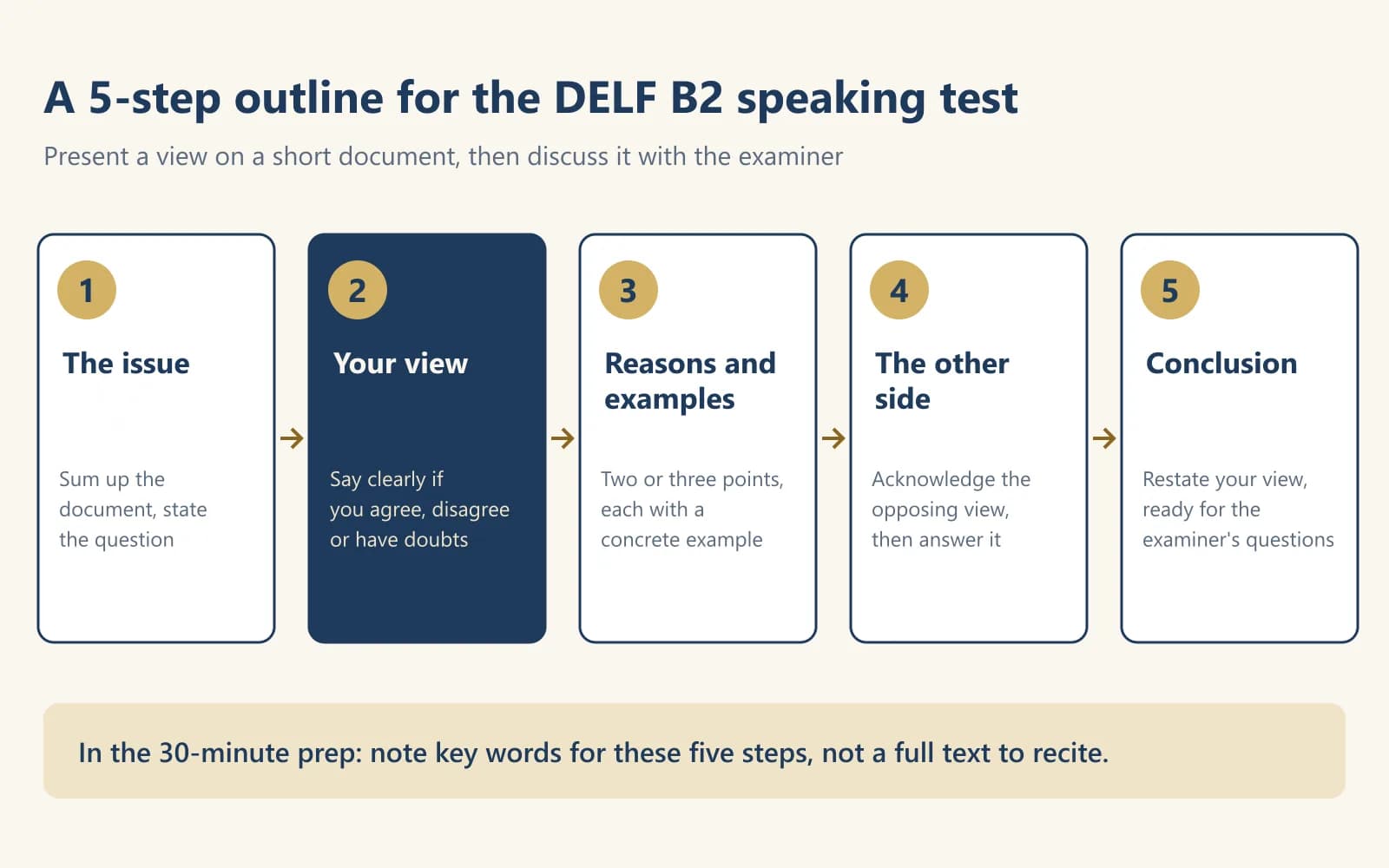
Speaking: learn an outline, not a script
In the 30 minutes of preparation, note only key words and the shape of your argument. You will sound more natural and respond more flexibly when the examiner follows up.
Sit full papers against the clock
Full papers train you to pace yourself and stay focused. After each one, note why you lost marks and adjust how you study. Prefer the sample papers, audio and candidate guides published by France Éducation international; with prep books, check which exam format they follow.
The DELF and DALF path at Wobridge
Wobridge splits DELF and DALF preparation into three consecutive group courses. You join at your current level rather than starting over.
| Course | Entry level | Target | Length |
|---|---|---|---|
| DELF Exam Prep 0 – A2 | No French yet | A1 – A2 | 6 months |
| DELF Exam Prep A2 – B2 | A2 | B1 – B2 | 8 months |
| DALF Exam Prep B2 – C2 | B2 | C1 – C2 | 10 months |

See each course: DELF 0 – A2, DELF A2 – B2, DALF B2 – C2. If the body you are applying to asks for TCF or TEF instead of DELF, see the other courses on the French page.
Registering and getting your results
Before registering, check the exam centre’s notice for levels, versions, dates, deadlines, fees and the documents to bring. Do not plan around fees or dates copied from old articles. When results come out also depends on what your centre announces.
Where to start
Not sure whether to sit A2, B1 or B2? Leave your details so Wobridge can assess your level and suggest the right course, or try a paper yourself on the practice page.
Knowing the level, the exam format and the pass rules is the first step; the rest is steady practice in all four skills.
Topics
- Overview
- Choosing a test
- Marking criteria