TOEFL iBT and IELTS Academic both measure English for academic settings, and many institutions accept either. The differences lie in how they ask, not in difficulty.
This article compares the four differences that matter, so you can choose by how you work.
Four main differences
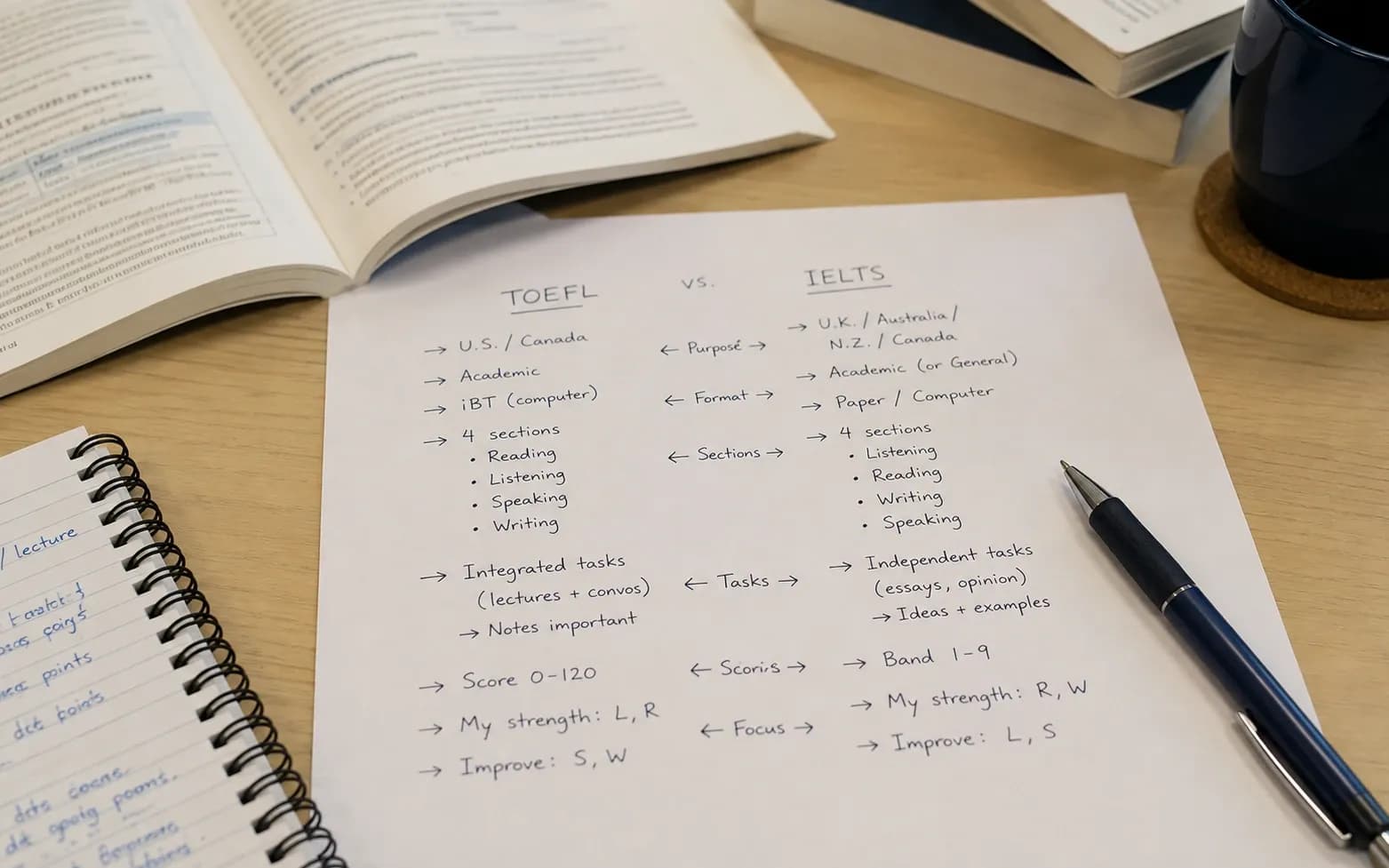
| TOEFL iBT | IELTS Academic | |
|---|---|---|
| Delivery | On computer | On paper or computer |
| Speaking | Into a microphone, with short preparation time | A face-to-face interview with an examiner |
| Question types | Mostly multiple choice | Varied: gap-fill, matching, true/false |
| Scale | 0 – 120 | Band 0 – 9 |
The difference worth weighing most is Speaking. People comfortable talking to a person usually do better on IELTS; people who find that daunting often prefer a microphone.
Note-taking is a marked skill
TOEFL permits notes throughout, and several tasks require hearing a lecture and then writing or speaking about it. Poor notes cost marks even when comprehension is fine.
A simple drill: listen to a short lecture, take notes, then speak for two minutes from the notes alone. Wherever you cannot reconstruct, the notes failed.
The integrated writing task
TOEFL includes a writing task where you read a passage, hear a lecture on the same topic, and write about how the two relate. IELTS has no equivalent.
It does not ask for your opinion — it asks for an accurate account of what each source says and whether they contradict or extend one another. Writers used to opinion essays lose marks exactly here.
How to choose
Three questions before deciding
Does your destination accept both, or only one?
Do you speak better to a person or to a microphone?
Are you faster at multiple choice or more comfortable writing by hand?
Answer those three and the choice usually makes itself — and it does not depend on which test is “harder”.
The figures here come from the test provider's published materials and may change. Requirements differ by institution — read the document issued by whoever receives your application.
Topics
- Overview
- Choosing a test