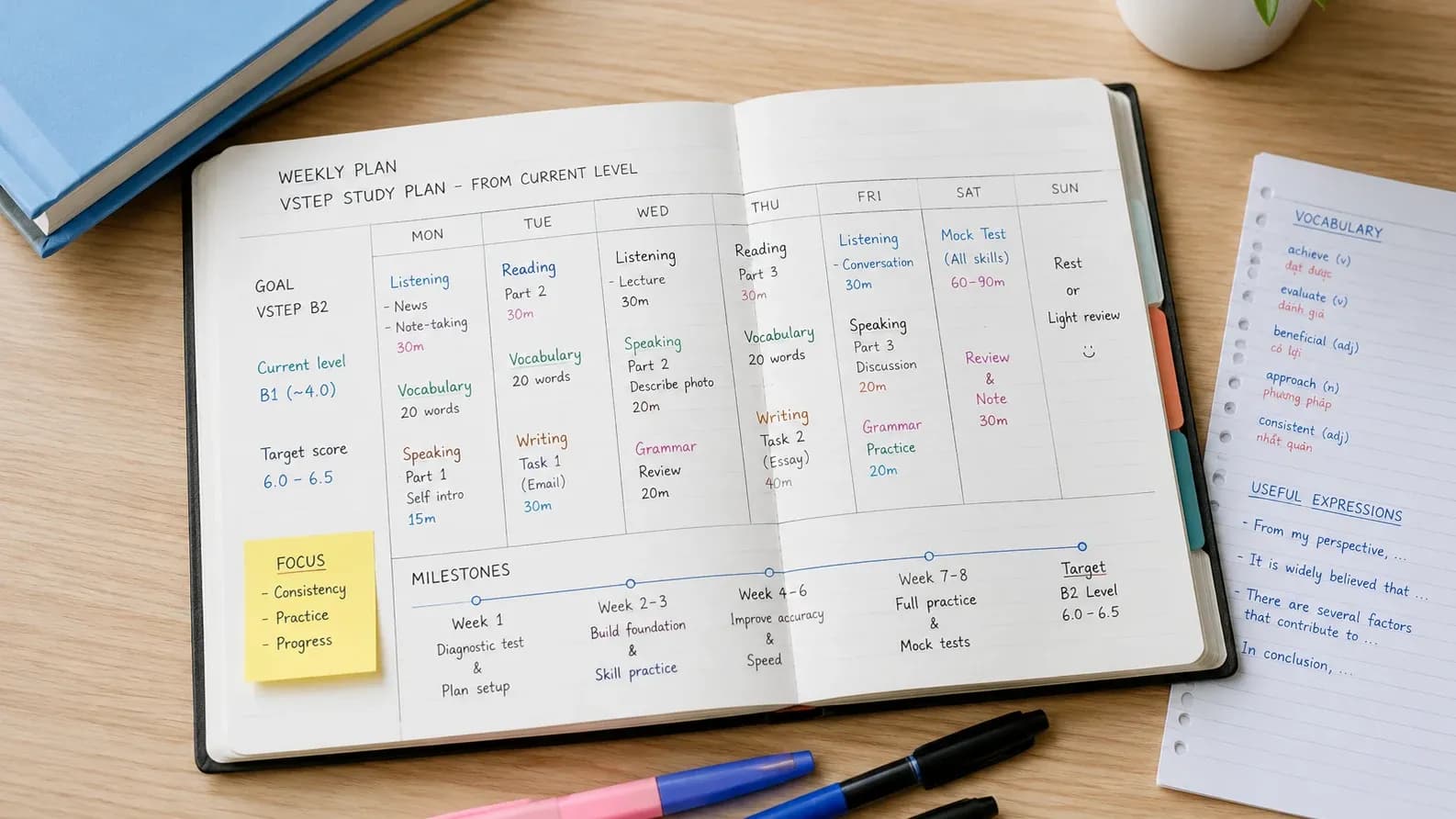
A useful study plan starts with a measurement, not a deadline. That measurement is one full mock, marked honestly, taken before any schedule is drawn.
This article is about reading that mock and dividing your time by what it shows.
Measure first, schedule second
The first mock is not there to judge you but to find the gap. The figure that matters is not the total but the distance between your strongest and weakest skill.
A narrow gap means an even split across four skills. A wide one means most of your time belongs to the weakest, because the level is computed from all four.
Divide time by the gap
| Situation | How to divide |
|---|---|
| Four skills close together | Even quarters, rotating weekly |
| One skill well behind | Half the time on that skill, the rest split three ways |
| Two skills behind | Two thirds on those two |
Listening and Reading improve with daily repetition; Writing and Speaking need feedback, so they improve per corrected session. A schedule should reflect that rather than four identical slots.
One checkpoint a week
Four steps, repeated weekly
Pick exactly one thing to change this week and write it down.
Practise it daily — short stretches beat one long weekend session.
At the end of the week, sit one real timed section as a check.
Record the result and choose next week's focus from it.
Without a weekly checkpoint every plan drifts: the learner stays busy without knowing whether anything is moving.
The final stretch
The last phase should shift from skill drills to full papers, because the stamina of a four-skill sitting can only be built by sitting through one.
But do not shift too early: full papers on an unfinished foundation produce a run of identical scores and say nothing about what to fix.
The figures here come from the test provider's published materials and may change. Requirements differ by institution — read the document issued by whoever receives your application.
Topics
- Study plan
- Practice