


Section 1 — Social survival
Reading · 20 phút · 14 câu
Nhóm câu 11 – 7
Questions 1-7. Complete the sentences below. Choose NO MORE THAN THREE WORDS from the text for each answer. Write your answers in boxes 1–7 on your answer sheet.
An Older Adult's Pool Pass
An Older Adult's Pool Pass offers cut-price entry at council swimming and fitness centres to residents aged 60 and over. It opens the door to a quiet morning length, a sauna after a day's gardening, or a water-aerobics class with a few friends.
Who can apply?
Any resident aged 60 or older can apply. You must show that you have reached this age. Valid forms of proof are a current passport, driver's licence or identity card. Alternatively, residents under 60 who are living with a recognised disability can apply. In their case, the council expects a written statement from a doctor, welfare officer or disability adviser; one of the submitted photographs must be officially stamped and carry the signature of that professional. For safety, one accompanying carer or instructor is admitted free.
Hand in the filled-in form at any council leisure centre, public library or town hall, with two recent photographs, the £18 fee and your evidence of eligibility. Allow up to ten working days for the pass to be issued.
Using your pass
The pass works on every day of the year — weekdays, weekends and public holidays alike. However, between 6 p.m. and 8 p.m. on a weekday (except during the school holidays), the pass carries a surcharge on top of the usual entry charge. For exact details of this, please ask at your nearest leisure centre or ring the council's bookings line.
Conditions
A pool pass without the holder's signature is not valid for entry. The pass and any tickets bought through it must stay with the named holder and may not be handed to another person. When staff inside the centre ask to see your pass during a visit, an inability to show it means paying the full adult rate — the only exception is when the door you came through was unstaffed.
The pass concession does not cover private swimming-lane bookings or learn-to-swim courses run by outside instructors. In either case, the full adult rate applies, even to members holding a valid pass.
Điền không quá 3 từ cho mỗi chỗ trống.
- 1.Younger candidates qualify by having a .
- 2.For applicants under 60, approved verifiers sign each photograph and have it .
- 3.At certain times of the year, the does not apply, at any time during the day.
- 4.If a pass doesn't have your on it, you cannot get in.
- 5.Discounts received through the pass cannot be enjoyed by .
- 6.If the entrance used was , the concession still applies despite a missing pass.
- 7.When pass holders want to reserve a lane for themselves or a lesson from a hired coach, they pay the .
Nhóm câu 28 – 14
Questions 8-14. Complete the summary below. Choose NO MORE THAN THREE WORDS from the text for each answer. Write your answers in boxes 8–14 on your answer sheet.
SPORTS CENTRE INFORMATION
Riverside Community Sports Centre offers a range of plans for members and casual visitors.
PLAN
DISCOUNT*
NOTES
pay-as-you-go
full rate
per visit, no commitment
junior plan
25%
members aged 6 to 17
student plan
25%
full-time student regardless of age
Pool Pass plan
25%
Older Adult's Pool Pass holders
off-peak plan
20%
weekdays, 10 am to 4 pm
50-session bundle
15%
valid 6 months from purchase
100-session bundle
30%
valid 12 months from purchase
* Only one plan discount may be applied to each booking.
PLAN CANCELLATIONS
Members may cancel their plan within a 14-day cooling-off period for a full refund of the price they paid. Once that period has ended, an early termination fee of 20% of the unused plan value will apply to any cancellation. (Bundle plans are non-refundable in either case and cannot be transferred to another person.)
FREEZING YOUR PLAN
Members may freeze their plan once during its term for up to 30 days, with medical evidence required, in return for an administration charge equal to 5% of the original plan price.
INFORMATION OF INTEREST TO USERS
When you fill in the registration form online, please check that the personal information and the type of plan you want are exactly as you entered them; registration must be completed at least 24 hours before your first planned swim so that staff can confirm the account.
Please bring your own swimwear, a towel and a padlock for the lockers; goggles and caps can be rented at the kiosk.
For private lessons with one of our coaches or to reserve a place at a scheduled event, please contact the Bookings Office. Lessons cancelled with less than 48 hours' notice are treated as no-shows; limited make-ups can be arranged.
OUR PROGRAMME IS GUARANTEED
If the centre does not fulfil any term of your plan agreement, the full plan fee will be refunded, provided the centre is responsible for the breach.
Điền không quá 3 từ cho mỗi chỗ trống.
A student with a recognised disability is offered a concession of 8. People who need one-on-one coaching at the centre should call the 9. Outside the first two weeks of grace, 10 of what has not been used is retained on any cancellation, while anyone pausing their plan for around a month is billed 11 of what they first paid as a service fee. These conditions are unavailable in the case of 12.
It is the member's responsibility to make sure the 13 and details such as their full name and contact information in their application are correct.
Members should plan to apply for membership no later than 14 ahead of their first time in the pool. Members may bring their own swimwear, a towel and a padlock for the lockers, while goggles and caps can be rented at the kiosk. The plan fee will be refunded in full if the centre breaks any term of the plan agreement.
Section 2 — Workplace
Reading · 20 phút · 13 câu
Nhóm câu 115 – 21
Questions 15-21. Complete the sentences below. Choose ONE WORD ONLY from the text for each answer. Write your answers in boxes 15-21 on your answer sheet.
Learning to Handle Difficult Conversations at Work
Few situations cause employees more anxiety than raising a sensitive issue at work. Whether the matter involves requesting a pay rise or addressing a colleague whose conduct has become disruptive, many people prefer silence to an uncomfortable exchange. This reluctance is understandable: no one wants to be regarded as a source of conflict, direct exchanges can feel unsettling, and some employees assume that speaking up will achieve little. Nevertheless, avoidance seldom resolves the underlying difficulty. With preparation and the right approach, these conversations can become considerably more manageable.
The process should begin with careful planning. Consider how long the discussion may require and where it should take place, as this can strongly influence how both parties respond. A formal boardroom or manager's office may appear intimidating and place the other person on the defensive, whereas a crowded café offers too little privacy. A quiet, neutral and reasonably informal location is generally the wisest choice.
It is equally important to prepare what you intend to say. Note the central points you need to communicate, then practise expressing them aloud. Recording yourself and listening back can reveal whether your explanation is clear, measured and concise. The purpose is not to memorise a rigid script, but to organise your thoughts so that anxiety does not obscure your message. Rehearsing with a trusted friend may also help you anticipate possible responses and speak with greater confidence.
Language requires particular attention because the same concern can be expressed constructively or confrontationally. Compare "Steve, you keep missing deadlines and you are delaying the entire team" with "Steve, I have noticed that you seem under considerable pressure lately. Is there anything I can do to help?" The first statement assigns blame and is likely to provoke resistance; the second communicates concern and makes you come across as looking for solutions. Collaborative phrasing promotes openness, preserves mutual respect and increases the likelihood of a productive outcome.
Empathy is also essential, even when the other person's actions have become frustrating. Their difficulties may result from an excessive workload, personal pressure or uncertainty about particular skills. Considering these possibilities does not excuse poor results, but it can help you address the problem without making premature assumptions.
Finally, regulate your emotions throughout the discussion. Slow breathing can help calm the body, while brief pauses allow you to respond thoughtfully rather than impulsively. Remaining composed makes it easier to listen carefully, express concerns accurately and prevent the conversation from turning into an unnecessary quarrel.
Điền không quá 1 từ cho mỗi chỗ trống.
- 15.Confronting a co-worker whose is causing problems for the team can be difficult.
- 16.Employees often fear that others will view them as a person who stirs up in the workplace.
- 17.For a sensitive talk, it is best to select the most suitable .
- 18.Consulting a can prepare you for how the other person might react.
- 19.A speaker who sounds as if they want to find to the problem is more likely to succeed.
- 20.Imagining the other person's situation helps you avoid hasty when raising the issue.
- 21.If you stay calm, the discussion is less likely to eventually become a dispute that is .
Nhóm câu 222 – 27
Questions 22-27. Complete the notes below. Choose ONE WORD ONLY from the text for each answer. Write your answers in boxes 22-27 on your answer sheet.
Turning a New Business into a Success
Being your own boss brings real rewards, yet there's no guarantee things will work out. Official figures show that around half of small enterprises collapse within their first two years — but by taking sensible precautions, you can greatly improve your odds.
Start by asking whether your company has a well-defined mission, annual targets and a long-range plan. Any goals you set should be precise, realistic and easy to measure, and you should review them regularly, replacing them with fresh ones where necessary. Above all, share your vision and objectives with your staff; since their jobs depend on the company doing well, they need to understand exactly what's expected of them. It's also worth involving them in the goal-setting process itself, because people work harder towards targets they helped to create.
Running out of money is the most common reason small firms go under, which makes keeping a close eye on cashflow essential. Note down when large bills — tax, rent, business rates — fall due, and confirm you'll have sufficient funds available at those moments. In addition, try to build up an emergency cash reserve covering several months of expenses, as this cushion can keep you trading through unexpected quiet periods.
If you plan to go into business with someone else, selecting the right partner matters enormously. Having chosen, draw up a formal agreement defining each person's duties and entitlements, and covering what happens if problems emerge — can one partner buy the other's share, or must the whole enterprise be wound up, potentially destroying a thriving business? Schedule regular, honest meetings with your partner as well, since small disagreements that are discussed early rarely grow into the kind of disputes that split partnerships apart.
Finally, whether an idea flourishes or flops depends on knowing your market and judging demand correctly. A product with only a tiny customer base will never generate enough sales to sustain a company. Spend time researching your rivals and working out what sets you apart — superior service, perhaps, or lower prices — because ultimately it comes down to why buyers should choose you over the competition. Don't stop researching once you've launched, either; regularly collecting customer feedback tells you how tastes are shifting and lets you adapt before your rivals do.
Launching a business involves countless decisions, but steering clear of these familiar traps will give yours a solid chance of thriving.
Điền không quá 1 từ cho mỗi chỗ trống.
Keys to Making a Startup Survive
Independence is appealing, but roughly 22 of new ventures don't last beyond year two.
Clear direction and goal management
Establish a defined purpose plus short- and long-term objectives
Establish clear targets and remember to 23 them periodically to make alterations if needed
Make sure 24 are aware of these goals and let them participate in shaping targets
Financial discipline
Insufficient funds are the leading cause of collapse
Record when sizeable 25 must be paid, and ensure money is on hand
Maintain a backup fund equal to several months' costs to survive slow spells
Managing partnerships
Choose a co-owner carefully
Put roles, 26, and exit arrangements in writing before trouble arises
Hold frequent open discussions so minor friction doesn't escalate into a breakup
Understanding the marketplace
Verify there's enough demand to support the venture
Find out how your product differs from what 27 offer
Continue gathering customer input after launch to respond to changing preferences
Section 3 — General interest
Reading · 20 phút · 13 câu
Nhóm câu 128 – 30
Questions 28-30. Do the following statements agree with the information given in the reading passage? In boxes 14-16 on your answer sheet, write: TRUE if the statement agrees with the information FALSE if the statement contradicts the information NOT GIVEN if there is no information on this
WATER TREATMENT: REED BED
In recent years, it has been shown that plants, more accurately roots, play a crucial part in purifying dirty water before it enters seas and rivers. In 15th-century Britain, dirty water was purified by passing through the wetlands. People began to realize that the “natural” way of water purification was effective. Nowadays, subsurface flow wetlands (SSFW) are a common alternative in Europe for the treatment of wastewater in rural areas. Mainly in the last 10 to 12 years, there has been a significant growth in the number and size of the systems in use. The conventional mechanism of water purification used in big cities where there are large volumes of water to be purified is inappropriate in rural areas.
The common reed has the ability to transfer oxygen from its leaves, down through its stem and rhizomes, and out via its root system. As a result of this action, a very high population of microorganisms occurs in the root system, in zones of aerobic, anoxic, and anaerobic conditions. As the wastewater moves very slowly through the mass of reed roots, this liquid can be successfully treated. The reason why they are so effective is often that within the bed’s root sector, natural biological, physical, and chemical processes interact with one another to degrade or remove a good range of pollutants.
Dirty water from households, farms and factories consumes a lot of oxygen in the water, which will lead to the death of aquatic creatures. Several aquatic plants are important in purifying water. They not only absorb carbon dioxide and release oxygen into the water, improving the environment for fish, but also absorb nutrients from the water as well. Britain and the G.S. differ in their preference for plants to purify water. Bulrushes (Scirpus spp.) and rushes (Juncus spp.) are excellent water purifiers. They remove excess nutrients from the water as well as oil and bacteria such as Escherichia coli and Salmonella. However, algae grow freely in summer and die off in winter. Their remains foul the bottom of the pool.
Artificial reed beds purify water in both horizontal and downflow ways. The reeds succeed best when a dense layer of root hairs has formed. It takes three years for the roots to fully develop. Which type of wetland a certain country applies varies widely depending on the country in Europe and its main lines of development. Besides the development of horizontal or vertical flow wetlands for wastewater treatment, the use of wetlands for sludge treatment has been very successful in Europe. Some special design lines offer the retention of microbiological organisms in constructed wetlands, the treatment of agricultural wastewater, the treatment of some kinds of industrial wastewater, and the control of diffuse pollution.
If the water is slightly polluted, a horizontal system is used. Horizontal-flow wetlands may be of two types: free-water surface-flow (FWF) or sub-surface water-flow (SSF). In the former, the effluent flows freely above the sand/gravel bed in which the reeds etc. are planted; in the latter, effluent passes through the sand/gravel bed. In FWF-type wetlands, effluent is treated by plant stems, leaves and rhizomes. Such FWF wetlands are densely planted and typically have water depths of less than 0.4m. However, dense planting can limit the diffusion of oxygen into the water. These systems work particularly well for low-strength effluents or effluents that have undergone some forms of pretreatment and play an invaluable role in tertiary treatment and the polishing of effluents. The horizontal reed flow system uses a long reed bed, where the liquid slowly flows horizontally through it. The length of the reed bed is about 100 meters. The downside of horizontal reed beds is that they use up lots of land space, and they do take quite a long time to produce clean water.
A vertical flow (downflow) reed bed is a sealed, gravel-filled trench with reeds growing in it. The reeds in a downflow system are planted in a bed 60cm deep. In vertical flow reed beds, the wastewater is applied to the top of the reed bed, flows down through a rhizome zone with sludge as a substrate, then through a root zone with sand as a substrate, followed by a layer of gravel for drainage, and is collected in an underdrainage system of large stones. The effluent flows onto the surface of the bed and percolates slowly through the different layers into an outlet pipe, which leads to a horizontal flow bed where it is cleaned by millions of bacteria, algae, fungi, and microorganisms that digest the waste, including sewage. There is no standing water, so there should be no unpleasant smells.
Vertical flow reed bed systems are much more effective than horizontal flow reed beds, not only in reducing biochemical oxygen demand (BOD) and suspended solids (SS) levels but also in reducing ammonia levels and eliminating smells. Usually considerably smaller than horizontal flow beds, they are capable of handling much stronger effluents which contain heavily polluted matter and have a longer lifetime value. A vertical reed bed system works more efficiently than a horizontal reed bed system, but it requires more management, and its reed beds are often operated for a few days then rested, so several beds and a distribution system are needed.
The natural way of water purification has many advantages over the conventional mechanism. The natural way requires less expenditure for installation, operation and maintenance. Besides, it looks attractive and can improve the surrounding landscape. Reed beds are natural habitats found in floodplains, waterlogged depressions and estuaries. The natural bed systems are a biologically proven, environmentally friendly and visually unobtrusive way of treating wastewater, and have the extra virtue of frequently being better than mechanical wastewater treatment systems. Over the medium to long term, reed bed systems are, in most cases, more cost-effective to install than any other wastewater treatment. They are naturally environmentally sound, protecting groundwater, dams, creeks, rivers and estuaries.
- 28.
There has been little change in the use of subsurface flow wetlands over the last decade.
- ATRUE
- BFALSE
- CNOT GIVEN
- 29.
In the reed roots, there is a series of processes that help break down the pollutants.
- ATRUE
- BFALSE
- CNOT GIVEN
- 30.
Escherichia coli is the most difficult bacterium to eliminate.
- ATRUE
- BFALSE
- CNOT GIVEN
Nhóm câu 231 – 33
Questions 31-33. Complete the diagram below. Choose ONE WORD ONLY from the passage for each answer.
WATER TREATMENT: REED BED
In recent years, it has been shown that plants, more accurately roots, play a crucial part in purifying dirty water before it enters seas and rivers. In 15th-century Britain, dirty water was purified by passing through the wetlands. People began to realize that the “natural” way of water purification was effective. Nowadays, subsurface flow wetlands (SSFW) are a common alternative in Europe for the treatment of wastewater in rural areas. Mainly in the last 10 to 12 years, there has been a significant growth in the number and size of the systems in use. The conventional mechanism of water purification used in big cities where there are large volumes of water to be purified is inappropriate in rural areas.
The common reed has the ability to transfer oxygen from its leaves, down through its stem and rhizomes, and out via its root system. As a result of this action, a very high population of microorganisms occurs in the root system, in zones of aerobic, anoxic, and anaerobic conditions. As the wastewater moves very slowly through the mass of reed roots, this liquid can be successfully treated. The reason why they are so effective is often that within the bed’s root sector, natural biological, physical, and chemical processes interact with one another to degrade or remove a good range of pollutants.
Dirty water from households, farms and factories consumes a lot of oxygen in the water, which will lead to the death of aquatic creatures. Several aquatic plants are important in purifying water. They not only absorb carbon dioxide and release oxygen into the water, improving the environment for fish, but also absorb nutrients from the water as well. Britain and the G.S. differ in their preference for plants to purify water. Bulrushes (Scirpus spp.) and rushes (Juncus spp.) are excellent water purifiers. They remove excess nutrients from the water as well as oil and bacteria such as Escherichia coli and Salmonella. However, algae grow freely in summer and die off in winter. Their remains foul the bottom of the pool.
Artificial reed beds purify water in both horizontal and downflow ways. The reeds succeed best when a dense layer of root hairs has formed. It takes three years for the roots to fully develop. Which type of wetland a certain country applies varies widely depending on the country in Europe and its main lines of development. Besides the development of horizontal or vertical flow wetlands for wastewater treatment, the use of wetlands for sludge treatment has been very successful in Europe. Some special design lines offer the retention of microbiological organisms in constructed wetlands, the treatment of agricultural wastewater, the treatment of some kinds of industrial wastewater, and the control of diffuse pollution.
If the water is slightly polluted, a horizontal system is used. Horizontal-flow wetlands may be of two types: free-water surface-flow (FWF) or sub-surface water-flow (SSF). In the former, the effluent flows freely above the sand/gravel bed in which the reeds etc. are planted; in the latter, effluent passes through the sand/gravel bed. In FWF-type wetlands, effluent is treated by plant stems, leaves and rhizomes. Such FWF wetlands are densely planted and typically have water depths of less than 0.4m. However, dense planting can limit the diffusion of oxygen into the water. These systems work particularly well for low-strength effluents or effluents that have undergone some forms of pretreatment and play an invaluable role in tertiary treatment and the polishing of effluents. The horizontal reed flow system uses a long reed bed, where the liquid slowly flows horizontally through it. The length of the reed bed is about 100 meters. The downside of horizontal reed beds is that they use up lots of land space, and they do take quite a long time to produce clean water.
A vertical flow (downflow) reed bed is a sealed, gravel-filled trench with reeds growing in it. The reeds in a downflow system are planted in a bed 60cm deep. In vertical flow reed beds, the wastewater is applied to the top of the reed bed, flows down through a rhizome zone with sludge as a substrate, then through a root zone with sand as a substrate, followed by a layer of gravel for drainage, and is collected in an underdrainage system of large stones. The effluent flows onto the surface of the bed and percolates slowly through the different layers into an outlet pipe, which leads to a horizontal flow bed where it is cleaned by millions of bacteria, algae, fungi, and microorganisms that digest the waste, including sewage. There is no standing water, so there should be no unpleasant smells.
Vertical flow reed bed systems are much more effective than horizontal flow reed beds, not only in reducing biochemical oxygen demand (BOD) and suspended solids (SS) levels but also in reducing ammonia levels and eliminating smells. Usually considerably smaller than horizontal flow beds, they are capable of handling much stronger effluents which contain heavily polluted matter and have a longer lifetime value. A vertical reed bed system works more efficiently than a horizontal reed bed system, but it requires more management, and its reed beds are often operated for a few days then rested, so several beds and a distribution system are needed.
The natural way of water purification has many advantages over the conventional mechanism. The natural way requires less expenditure for installation, operation and maintenance. Besides, it looks attractive and can improve the surrounding landscape. Reed beds are natural habitats found in floodplains, waterlogged depressions and estuaries. The natural bed systems are a biologically proven, environmentally friendly and visually unobtrusive way of treating wastewater, and have the extra virtue of frequently being better than mechanical wastewater treatment systems. Over the medium to long term, reed bed systems are, in most cases, more cost-effective to install than any other wastewater treatment. They are naturally environmentally sound, protecting groundwater, dams, creeks, rivers and estuaries.
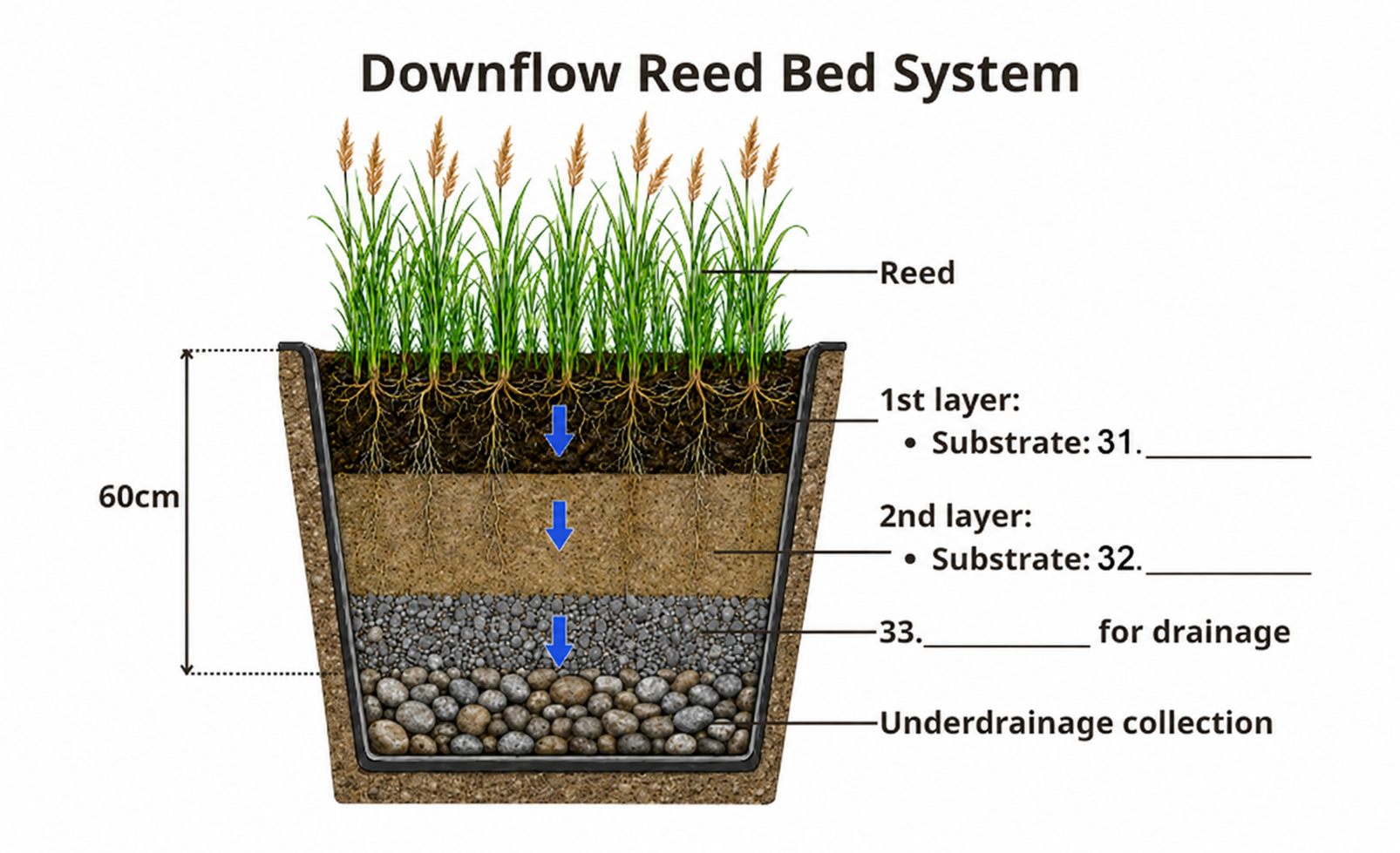
Điền không quá 1 từ cho mỗi chỗ trống.
31
32
33
Nhóm câu 334 – 38
Questions 34-38. Look at the five characteristics A-E below. Match each blank 34-38 with the correct characteristic. Write the correct letter, A-E, in boxes 34-38 on your answer sheet.
Downflow system characteristics
A. Greater treatment efficiency
Vertical flow reed bed systems are much more effective than horizontal flow reed beds, not only in reducing biochemical oxygen demand (BOD) and suspended solids (SS) levels but also in reducing ammonia levels and eliminating smells.
B. Lower space requirements
Usually considerably smaller than horizontal flow beds, they are capable of handling much stronger effluents which contain heavily polluted matter and have a longer lifetime value.
C. Capacity to handle more contaminated wastewater
Usually considerably smaller than horizontal flow beds, they are capable of handling much stronger effluents which contain heavily polluted matter and have a longer lifetime value.
D. Greater management demands
A vertical reed bed system works more efficiently than a horizontal reed bed system, but it requires more management, and its reed beds are often operated for a few days then rested, so several beds and a distribution system are needed.
E. Need for multiple treatment units
A vertical reed bed system works more efficiently than a horizontal reed bed system, but it requires more management, and its reed beds are often operated for a few days then rested, so several beds and a distribution system are needed.
Danh sách lựa chọn
- AGreater treatment efficiency
- BLower space requirements
- CCapacity to handle more contaminated wastewater
- DGreater management demands
- ENeed for multiple treatment units
Mỗi lựa chọn chỉ dùng cho một câu.
- 34.
Advantage (34) of downflow systems compared with horizontal-flow systems.
- 35.
Advantage (35) of downflow systems compared with horizontal-flow systems.
- 36.
Advantage (36) of downflow systems compared with horizontal-flow systems.
- 37.
Disadvantage (37) of downflow systems compared with horizontal-flow systems.
- 38.
Disadvantage (38) of downflow systems compared with horizontal-flow systems.
Nhóm câu 439 – 40
Questions 39-40. Look at the two advantages A-B below. Choose the correct advantage for each answer. Write the correct letter, A or B, in boxes 39-40 on your answer sheet.
Natural water purification advantages
A. It involves a low operating cost
The natural way requires less expenditure for installation, operation and maintenance. Besides, it looks attractive and can improve the surrounding landscape.
B. It is visually appealing
The natural way requires less expenditure for installation, operation and maintenance. Besides, it looks attractive and can improve the surrounding landscape.
Danh sách lựa chọn
- AIt involves a low operating cost
- BIt is visually appealing
Mỗi lựa chọn chỉ dùng cho một câu.
- 39.
One advantage of the natural water purification system.
- 40.
Another advantage of the natural water purification system.